Many homeowners worry about the water their family drinks and uses daily. One option is to have a lab test your water, but that provides you with no assurances down the line. If you want to ensure that your water is clean and safe, water treatment is the most effective and reliable approach. Let’s explore the most common water treatment solutions used in homes in Las Vegas, NV.
Point-of-Use Water Filters
Point-of-use filters are often the most affordable form of water treatment. These include countertop canister filters, under-the-sink canister filters, refrigerator filters, and filter pitchers. While relatively cheap initially, there are downsides. They’re generally limited to one tap. That means you’ll need multiple units to get good coverage throughout a home. They often don’t provide enough flow rate for use beyond drinking water and light cooking. These filter media replacements can be pricey and considerably increase your costs over the life of the system.
Point-of-Entry Water Treatment Systems
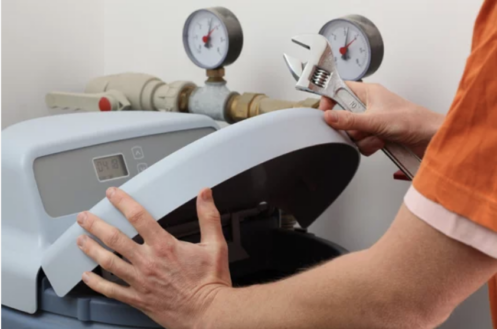
Point-of-entry water treatment systems provide filtered water throughout a home. We install them between the water main and the home’s plumbing. This is an option whether you have a well or municipal water. Your system will provide clean water from all faucets, showerheads, and other fixtures. Your appliances, such as water heaters, dishwashers, and washing machines, will use that cleaner water too. POE systems are more expensive to purchase and install. That said, they can last for decades with proper maintenance. You also won’t have to change out the media as often.
Reverse Osmosis Systems
Reverse osmosis systems are a type of POE water purifier. They’re very effective in that they eliminate almost all pollutants found in water. This includes particulates but also pathogens, chemicals, and gases. These systems for home use often have three or four stages. The first stage is an inexpensive prefilter that extends the life of the main stage. The second or main stage involves a high-pressure pump and a semi-permeable membrane. During the RO process, that membrane blocks pollutants, which the system flushes as wastewater. The third stage is a remineralization filter. This is necessary because RO removes good minerals too. Some systems have a tank for clean water storage as a fourth stage.
System Efficiency and Capacity
There are two important considerations with RO systems. One is water consumption. RO systems use more water than they deliver. Most homeowners will want to target a highly efficient system. Many of the top systems get close to a 1:1 ratio.
The other consideration is capacity. RO is a slow process relative to other water purification systems. The industry measures RO systems in gallons per day. The average home needs between 50 and 100 GPD. While a tank isn’t a requirement, it’s a worthwhile consideration. Having a tank helps to avoid low water pressure when demand is high.
Water Purification Systems
Traditional water purifiers don’t use the RO process. Instead, they force water through one or more filter stages. With our help, you can customize your system to have the stages it needs to deal with your concerns. There’s no elimination of good minerals and no need for remineralization. An RO system, on the other hand, is a water softener as well. Traditional water purifiers aren’t. If you want softening or conditioning, you’ll have to add them as additional components.
Flow Rate
This form of water purification is faster than RO. The industry does not measure it in GPD but rather in gallons per minute (GPM). Sizing is important because you need a flow rate that accounts for every fixture and appliance you want to run simultaneously. If the flow rate is lower than your peak demand, issues can include low water pressure.
Absorbent Filtration
Absorbent filtration is the most common type of water treatment for the home. Activated carbon is the most prevalent substance used for this purpose. Both POU systems and POE systems use it. Some use it exclusively, but many pair it with at least mechanical filtration. Activated carbon results in palatable drinking water because it absorbs unpleasant smells and tastes. It also absorbs chemicals, including pharmaceuticals and pesticides, and gases, including volatile organic compounds.
Mechanical Filtration
Many water treatment systems have a prefilter to preserve the more expensive filter media. Some systems use the activated carbon as the prefilter. Most have a dedicated prefilter, which is particularly important for homes with well water. Dirt and silt are bigger concerns with wells than with municipal water.
Most systems will have a separate mechanical filter, often called a sediment filter, for the primary mechanical filtration. The most important characteristic of a sediment filter is its pore size. That dictates which particles the system can trap. Be sure to look for the absolute value rather than a median or average value. With an absolute value of one micron or less, a filter can remove cysts, such as cryptosporidium.
Germicidal Light
A sediment filter with a small pore size can trap some pathogens. To neutralize 99.9% of them, experts recommend a water purifier with an ultraviolet (UV) lamp. That lamp will give off a germicidal light in the form of UV-C. The UV-C light will kill most of the bacteria, viruses, and parasites in your water. This significantly reduces the chance of gastrointestinal distress and more serious illnesses.
Water Softening
The amount of calcium and magnesium in your water dictates how soft or hard it is. The more minerals present, the harder the water is. Hard water is safe to drink, but some people find the texture unpleasant. It makes for inconsistent drink and cooking recipes. Hard water is bad for skin and hair health. It also damages plumbing and appliances over time and decreases energy efficiency. The most common water softener for home use is salt-based. These systems use rechargeable resin beads to exchange the magnesium and calcium in your water with either sodium or potassium.
Water Conditioning
Water conditioners are filter stages used to condition your water for drinking. The remineralization filters common for RO systems are one example of this. For traditional water purifiers, we often use a conditioner to adjust pH. If your water is slightly acidic, for instance, this stage can condition it to a neutral pH.
Product Certification
There are several certifications that you may want to consider when comparing water treatment systems. The Water Quality Association awards a Gold Seal to systems that meet their rigorous standards. The Environmental Protection Agency awards the WaterSense label to systems that use water efficiently. The Centers for Disease Control and Prevention also recommend looking for the National Sanitation Foundation label. NSF-certified systems will have a label that provides specifics about what they remove.
Would You Like to Install a Water Treatment System in Las Vegas?
[company_name] is a plumbing contractor that serves homeowners throughout Las Vegas. We specialize in customized water filtration systems. Our plumbers perform inspections, installations, maintenance, and repairs and are available around the clock for emergency services. We perform video camera inspections, hydrojetting, and rooter services. Our plumbers pipe and repipe water, gas, and sewer lines. We also install and service kitchen fixtures, bathroom fixtures, garbage disposals, leak detection systems, and tank and tankless water heaters. For further details or to schedule an appointment for plumbing installation, call today, or contact us online.