
Quick Summary
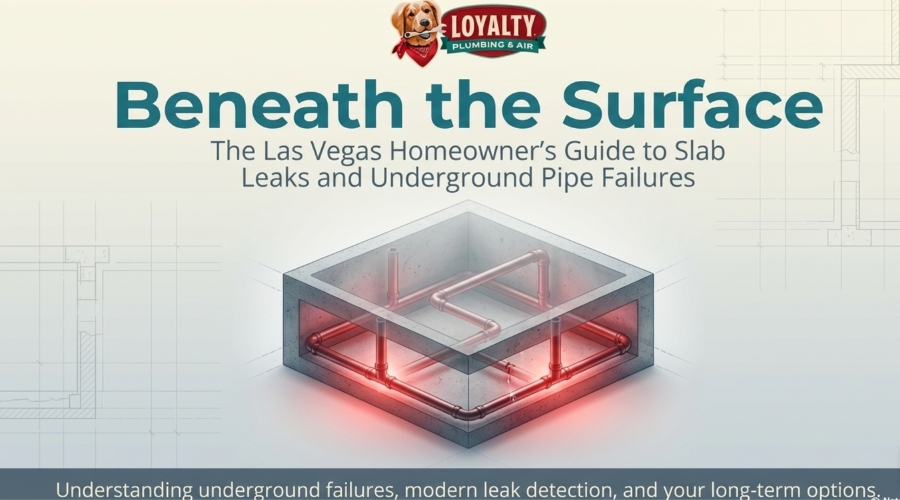
Water leak detection in Las Vegas is more than locating a drip — it’s identifying the root cause of a system under stress. Las Vegas homes sit on concrete slab foundations, with copper pipes running beneath the floor. Over time, hard water mineral content and chlorine degrade that copper, leading to pinhole leaks and slab failures. At Loyalty Plumbing & Air, we use Goldak leak detection equipment to precisely locate underground leaks — and once we find them, we walk homeowners through their real long-term options, including reroutes, repipes, and water main line replacements.
Who This Guide Is For
- Homeowners who hear water running when everything is off
- Anyone who received a high water bill without a clear explanation
- Las Vegas residents with warm spots on their floor or cracked tile
- Homeowners in older neighborhoods with original copper plumbing
- Anyone weighing repair versus replacement for an underground pipe leak
Why Slab Leaks Happen So Often in Las Vegas
Las Vegas homes are built on concrete slab foundations — there is no crawl space, no basement, and no easy access to the pipes running beneath your floors. That copper plumbing is buried directly in or below the slab, surrounded by soil that shifts with temperature, and constantly bathed in some of the hardest water in the country.
The water here is aggressive. Las Vegas water carries elevated levels of calcium, magnesium, and chlorine. Chlorine attacks rubber seals and gaskets. Calcium deposits build up inside pipe walls, restricting flow and increasing internal pressure. Together, these conditions accelerate corrosion on copper from the inside out.
The desert climate adds another layer. Ground temperatures in Las Vegas fluctuate more than most homeowners realize. Soil expansion and contraction stress the pipes that run beneath the slab, and over decades, that mechanical fatigue compounds with mineral damage. The result is predictable: pinhole leaks in copper that are often years in the making before a homeowner notices anything.
Using the PLAC framework — Pressure, Lack of maintenance, Age, and Calcium and corrosion — nearly every slab leak we evaluate in Las Vegas traces back to at least two or three of these factors working together. A 20-year-old home with original copper, no water treatment, and no pressure regulator check is exactly the environment where slab leaks develop.
Signs You May Have an Underground or Slab Leak
- Water bill increases without a change in usage
- The sound of running water when all fixtures are off
- Warm or hot spots on tile, vinyl, or hardwood floors
- Damp or soft flooring, baseboards, or drywall near the floor
- Mold or mildew odor without visible moisture
- Reduced water pressure throughout the home
- Cracks in flooring or tile separating from grout lines
- A water meter that continues to spin after shutting off all water sources
Any single one of these signs warrants a professional evaluation. Two or more together strongly suggest an active underground leak.
What Most Las Vegas Homeowners Don’t Realize
1. A slow leak can run for months before it’s visible. By the time a homeowner notices a warm floor or a spike in their water bill, water may have already been migrating through or beneath the slab for an extended period. What appears to be a small problem often involves significant moisture migration beneath the concrete.
2. The repair location is rarely the only vulnerable point. When copper pipe fails at one location after years of mineral stress and pressure fatigue, the rest of the pipe is under the same conditions. Repairing the pinhole and moving on leaves the homeowner with the same pipe, under the same water quality, in the same environment. The next failure is often a matter of when — not if.
3. Hard water is not just a nuisance — it is the root cause. Many homeowners associate hard water with spotty dishes or dry skin. In Las Vegas, it is a direct contributor to the corrosion that causes slab leaks. Without water treatment, copper pipes are fighting a losing battle against mineral-saturated water from day one.
4. Not all leak detection equipment is equal. Some companies estimate leak locations based on symptoms. A Loyalty Plumbing & Air professional uses Goldak leak detection equipment — professional-grade acoustic and electronic tools that allow us to pinpoint the exact location of an underground leak before any concrete is touched. This precision protects your property and gives you accurate information to make a real decision.
5. Opening the slab is not always the right answer. Many homeowners assume that finding the leak means cutting the floor. In many cases, a reroute or full repipe eliminates the need to work through the slab at all — and delivers a far better long-term outcome.
How a Loyalty Plumbing & Air Professional Diagnoses a Suspected Leak
Leak detection is a structured process. Here is how we approach it:
Step 1 — Initial Assessment We begin by listening to what the homeowner has observed: high water bills, sounds of running water, warm floors, or visible moisture. Each symptom helps us identify where to start.
Step 2 — Water Meter Verification We shut off all water sources in the home and observe the meter. A meter that continues to register movement confirms an active leak somewhere in the system.
Step 3 — Pressure Testing We isolate sections of the plumbing system and test pressure to determine whether the leak is on the cold supply, hot supply, or a specific line. This step narrows the location significantly before equipment is deployed.
Step 4 — Goldak Leak Detection Equipment We use Goldak professional leak detection tools — acoustic listening devices and electronic amplification equipment designed specifically for locating underground pipe failures. These tools allow us to pinpoint leak locations through concrete and soil with precision. We mark the location clearly before any work begins.
Step 5 — System-Wide Evaluation We don’t stop at the leak. While on-site, we evaluate the broader plumbing system: the age of the water heater, the condition of shutoff valves, the presence of an expansion tank, and whether a pressure regulator is installed and functioning. If the copper is failing in one place, we want to understand the full picture.
Step 6 — Presenting Structured Options Once the evaluation is complete, we present the homeowner with clear, honest options — repair, reroute, sectional repipe, or full repipe — along with the pros, cons, cost factors, and long-term expectations of each. The homeowner makes the decision. We provide the information.
Repair vs. Reroute vs. Repipe: How to Decide
This is the most important decision in the leak detection process, and it deserves a clear, honest breakdown.
Spot Repair — When It Is Considered
A direct repair at the leak location may be appropriate when:
- The home has newer copper or PEX plumbing
- The system is otherwise in good condition
- The pipe is accessible without cutting through slab
- Water treatment is already installed and functioning
- The homeowner clearly understands the limitations
The honest reality: In Las Vegas, once copper plumbing beneath a slab has failed at one point due to corrosion and mineral damage, the rest of that pipe is under the same conditions. A spot repair addresses the symptom, not the system. We offer this option with full transparency about what it means long-term.
Reroute — Often the Right Answer for a Single Line
A reroute involves abandoning the failed pipe section and running a new supply line through the wall, attic, or another accessible path — bypassing the slab entirely.
Reroutes are appropriate when:
- A single supply line is the source of the failure
- The rest of the system is in acceptable condition
- The homeowner wants to avoid major repipe investment
- The reroute path is accessible without major structural disruption
Reroutes use modern materials — typically PEX — that are more flexible, more resistant to mineral damage, and better suited for Las Vegas conditions than original copper.
Full Repipe — The Long-Term Solution
A full repipe replaces all supply lines throughout the home. In Las Vegas homes built before 2005 with original copper plumbing and no water treatment history, a full repipe is frequently the most cost-effective long-term decision.
Repipe is appropriate when:
- The home has aging copper throughout
- Multiple leaks or failures have already occurred
- The homeowner plans to stay in the property long-term
- Water treatment was never installed
- A real estate transaction requires system confidence
A full repipe eliminates the root infrastructure problem entirely and replaces it with modern materials built for the Las Vegas water environment.
Water Main Line Replacement
Underground main water lines — the pipe running from the city meter to the home — are subject to the same soil movement, pressure, and water quality stress as interior slab pipes. Main line failures often present as unusually soggy areas in the front yard, dramatic drops in pressure, or high water bills without an interior source.
When a main line fails, we generally recommend full replacement rather than spot repair for the same reason: the pipe has been in the same aggressive environment for the same number of years, and the failure point is rarely the only vulnerable section.
Cost Considerations for Leak Detection and Pipe Work in Las Vegas
We don’t provide pricing in content, and we won’t guess at costs here. What we will explain is what drives pricing on these projects:
- Leak detection service — professional Goldak equipment deployment, isolation testing, and location marking
- Accessibility — whether the leak is beneath tile, hardwood, or polished concrete affects restoration scope
- Reroute complexity — single-line reroutes are less involved than multi-line work
- Repipe scope — square footage, number of fixtures, and home layout all affect labor
- Permit requirements — Clark County and Las Vegas require permits on significant plumbing work; Loyalty Plumbing & Air pulls permits when required, no exceptions
- Material selection — PEX-A, PEX-B, and other modern materials each carry different price points
- Restoration — drywall, flooring, and tile work following any slab or wall access is a separate consideration
Scheduled, non-emergency work is typically less costly than emergency response. If you’ve noticed signs of a leak, calling early gives you better options.
DIY vs. Professional Leak Detection
When homeowners can reasonably check themselves:
- Watching the water meter for movement after shutting off all fixtures
- Looking for warm floor spots or visible moisture near baseboards
- Checking shutoff valves for signs of corrosion or moisture
When professional equipment is required: Underground leaks beneath concrete cannot be reliably located without acoustic and electronic detection equipment. Guessing at the location — or using generic plumbing tools — risks unnecessary slab cuts, missed locations, and property damage without solving the problem.
Beyond detection: any work involving the water supply system in Las Vegas requires a licensed Nevada plumber. Unpermitted plumbing work creates real liability exposure at resale and may void homeowner’s insurance coverage in the event of a water damage claim.
This is not an area for trial and error. The cost of one incorrectly placed slab cut often exceeds the cost of professional detection.
Frequently Asked Questions
How do I know if I have a slab leak? Common indicators include a water bill that increases without a change in usage, the sound of running water when all fixtures are off, warm or soft spots on your floor, or moisture appearing near baseboards. A Loyalty Plumbing & Air professional can confirm the presence and location of a leak with Goldak detection equipment and pressure testing.
Can a slab leak just be repaired at the spot? Yes — but in Las Vegas, we are transparent about what that means. Once copper pipe fails due to mineral corrosion and age, the surrounding pipe is under the same conditions. A spot repair is a short-term solution. We discuss this honestly and let homeowners choose with full information.
What is a pipe reroute and is it better than a repair? A reroute abandons the failed pipe section and runs a new supply line through an accessible path — typically walls or the attic — bypassing the slab entirely. It avoids cutting through concrete and uses modern materials. For a single-line failure, it is often the most practical long-term option.
How does Loyalty Plumbing & Air locate the leak? We use Goldak professional leak detection equipment — acoustic listening devices and electronic amplification tools designed for underground pipe location. Combined with pressure isolation testing, we pinpoint the exact location before any concrete is touched.
Does a slab leak repair require a permit in Las Vegas? Significant plumbing repairs and repipes in Clark County require permits. Loyalty Plumbing & Air pulls permits when required. This protects the homeowner, the installation, and the property at resale.
How long does a full repipe take? Most single-story Las Vegas homes can be repiped in one to two days. Larger homes or more complex layouts may take longer. Water is typically restored same day. Drywall patching and restoration follows separately.
Will my homeowner’s insurance cover a slab leak? Coverage varies by policy. Many policies cover sudden and accidental water damage but exclude gradual leaks or failures resulting from deferred maintenance. We recommend contacting your insurance provider directly with documentation from the detection process.
What should I do right now if I suspect a leak? Shut off the main water supply to the home if you believe the leak is active and causing damage. Then call for professional evaluation. Do not attempt to locate an underground leak without proper equipment — you risk unnecessary damage without accurate information.
Real Scenario: Henderson Home, Original Copper Plumbing
A homeowner in Henderson — a two-story home built in 1998, approximately 2,400 square feet — contacted Loyalty Plumbing & Air after noticing their water bill had increased by nearly 40% over three months. No visible moisture, no sound of running water, no obvious symptoms inside the home.
A Loyalty Plumbing & Air professional arrived, shut off all fixtures, and confirmed the water meter was still registering movement. Pressure isolation testing identified the failure on the hot supply line. Goldak detection equipment was deployed, and the leak was pinpointed to a location beneath the living room tile floor, approximately 14 feet from the water heater.
The homeowner was presented with three options: a spot repair through the slab, a hot line reroute through the attic, and a full repipe. The home had no water treatment, original copper throughout, and had never had a pressure regulator evaluated.
After reviewing the PLAC factors — aging copper, no maintenance history, 26 years of hard water exposure, and an unchecked pressure regulator — the homeowner elected the full repipe. The project was permitted, completed in two days, and a whole house water filtration system was added to protect the new plumbing. The homeowner’s water bill returned to normal within the first billing cycle.
Why Working With a Local Las Vegas Plumbing Company Matters
Las Vegas plumbing conditions are not generic. The water hardness here is among the highest in the country. The soil movement from desert temperature swings stresses buried pipe differently than soil in wetter climates. Slab foundation construction is the norm, not the exception. And Clark County has its own permit requirements and inspection process that a licensed local contractor understands from direct field experience.
Loyalty Plumbing & Air is locally owned and operated. Nick and Alexy are directly involved in every project. When we evaluate a Las Vegas slab leak, we are drawing on real experience from hundreds of similar homes across Henderson, Summerlin, North Las Vegas, Green Valley, and central Las Vegas neighborhoods built across four decades of local construction.
We know what 1990s copper looks like after 30 years of hard water. We know which neighborhoods were built with what materials. We know the permit process, the inspection standards, and the realistic long-term expectations for every option we present.
As a locally owned Las Vegas company, our name is on every job. The Golden Guarantee isn’t marketing language — it reflects our commitment to doing the work correctly and standing behind it.
Final Summary
Slab leaks are one of the most common plumbing failures in Las Vegas, and they are directly connected to the hard water, chlorine levels, and soil conditions unique to this area. If you are hearing running water, seeing an unexplained spike in your water bill, or noticing warm spots in your floor, do not wait.
Watch for:
- Unexplained water bill increases
- Running water sounds when everything is off
- Warm or soft floor areas
- Moisture near baseboards or flooring edges
When to call: As soon as two or more signs appear — or immediately if you suspect an active leak is causing damage.
Loyalty Plumbing & Air serves homeowners throughout Las Vegas, Henderson, North Las Vegas, and surrounding communities including Summerlin, Green Valley, Centennial Hills, Providence, Anthem, Enterprise, and Mountain’s Edge.
Schedule a Leak Detection Evaluation
If you suspect a water leak in your Las Vegas home, the first step is a professional evaluation with proper detection equipment.
Loyalty Plumbing & Air provides structured diagnostics, clear options, and honest guidance — without pressure, without guessing, and without unnecessary work.
Call us at (725) 237-2579 to schedule your evaluation.
Author Bio: Written by the licensed plumbing professionals at Loyalty Plumbing & Air — a Nevada licensed residential plumbing company serving Las Vegas, Henderson, and North Las Vegas. Loyalty Plumbing & Air specializes in slab leak detection, repipes, water heater systems, sewer services, and water treatment for the Las Vegas Valley.
Posted in Home Tips