

QUICK SUMMARY — FEATURED ANSWER
Gas line repair and installation in Las Vegas requires a Nevada-licensed plumbing professional with experience in both residential gas systems and the specific demands of desert climate construction. In Las Vegas, factors like soil movement from extreme temperature fluctuations, slab foundations, and aging home infrastructure can all contribute to gas line stress and deterioration. Whether you’re experiencing a suspected gas leak, planning a new appliance installation, or upgrading an aging system, having a licensed professional evaluate your gas line is the correct first step. Never attempt to diagnose or repair a gas line yourself — contact a qualified plumber immediately and, if you smell gas, leave the property and call your utility provider.
Who This Guide Is For
- Homeowners who smell gas or suspect a leak in their Las Vegas home
- Residents adding a gas appliance such as a range, dryer, outdoor grill, or fire pit
- Owners of older Las Vegas homes with aging black iron pipe systems
- Anyone planning a kitchen remodel, home addition, or utility upgrade
- Homeowners unsure whether their gas line meets current Clark County code
- Residents upgrading to tankless water heaters requiring dedicated gas lines
Why Gas Line Issues Happen in Las Vegas
Las Vegas sits in a high-desert environment where daytime temperatures can exceed 115°F and drop sharply at night. That thermal cycling — repeated expansion and contraction — puts mechanical stress on the materials that make up residential gas systems. In a city where slab-on-grade construction is the norm, buried gas lines beneath concrete foundations are subject to soil movement, shifting, and pressure that homeowners never see coming.
Many homes built between the 1970s and 1990s still rely on black iron pipe gas lines. While durable in controlled conditions, these systems can corrode over time, particularly in areas where moisture infiltrates through soil or where connections and fittings weren’t installed to modern code standards. Newer homes may use flexible corrugated stainless steel tubing (CSST), which offers installation advantages — but requires proper bonding and grounding to prevent damage from electrical surges, a specific requirement under the 2018 Uniform Plumbing Code and adopted Clark County standards.
Through the PLAC framework — Pressure, Lack of maintenance, Age, and Calcium/corrosion — Loyalty Plumbing evaluates every gas system issue at the root cause level, not just the visible symptom. In Las Vegas, age and pressure are particularly common contributors to gas line problems that homeowners don’t discover until the system is already stressed.
Signs You May Need Gas Line Service
WARNING SIGNS
- Smell of rotten eggs or sulfur anywhere in or near the home
- Hissing or whistling sounds near appliances, walls, or the gas meter
- Appliance pilot lights that frequently go out or won’t stay lit
- Gas appliances with unusually low flame output or pressure
- Dead grass or vegetation in a specific line path in your yard
- Unexplained increase in your NV Energy gas bill
- Visible corrosion, rust, or damage to accessible gas fittings
- Bubbling in standing water near gas line paths after rain
- Planning to add an appliance or extend gas service to a new area
- Remodeling a kitchen or laundry room that requires relocating lines
Important: If you smell gas, do not operate any switches, open flames, or appliances. Leave the home immediately, move a safe distance away, and call NV Energy’s emergency line. Only return once cleared by the utility provider. Then call Loyalty Plumbing at (702) 903-7223 for a licensed evaluation and repair.
What Most Las Vegas Homeowners Don’t Realize About Gas Lines
1. Older Flex Connections Are Common Failure Points
Many Las Vegas homes have appliances connected by corrugated metal flex connectors that were installed during the original build — sometimes 20 or 30 years ago. These connectors have a limited service life. They can crack, kink, or develop micro-leaks that aren’t always immediately detectable. A Loyalty Plumbing professional routinely evaluates flex connectors as part of any gas-related service call.
2. CSST Requires Proper Bonding to Be Code-Compliant
Corrugated stainless steel tubing (CSST) became widely used in Las Vegas new construction starting in the 1990s. However, early installations often didn’t include proper electrical bonding — a code requirement designed to protect the tubing from lightning-induced electrical surges. Many homes in Summerlin, Henderson, and Centennial Hills built in that era may have unbonded CSST that doesn’t meet current Clark County standards.
3. Adding an Appliance Isn’t Always as Simple as a Connection
Homeowners adding outdoor fire pits, gas ranges, tankless water heaters, or whole-home generators often underestimate the scope involved. Depending on your existing system’s capacity, a new high-BTU appliance may require a dedicated gas line, upgraded supply piping, or pressure regulation adjustments. Loyalty Plumbing sizes systems correctly from the start.
4. Soil Movement Under Slab Foundations Can Stress Buried Lines
In Las Vegas, the expansive desert soil beneath slab foundations can shift seasonally. This gradual movement can stress buried gas lines over years, eventually causing joint separation or hairline cracks. These types of failures often develop slowly and may go undetected until pressure testing reveals a problem.
5. Permits Are Not Optional for Gas Work
In Clark County, gas line installation and repair requires a permit when the scope involves new lines, extended runs, or structural modifications. Unpermitted gas work can affect your homeowner’s insurance coverage and create complications during a home sale. Loyalty Plumbing pulls permits when required — that’s non-negotiable.
How a Loyalty Plumbing Professional Diagnoses a Gas Line Problem
- Initial Safety Assessment — Technician confirms the area is safe to work in, checks for any active leak indicators, and evaluates all accessible gas components — meter, shut-off valves, exposed piping, and appliance connections.
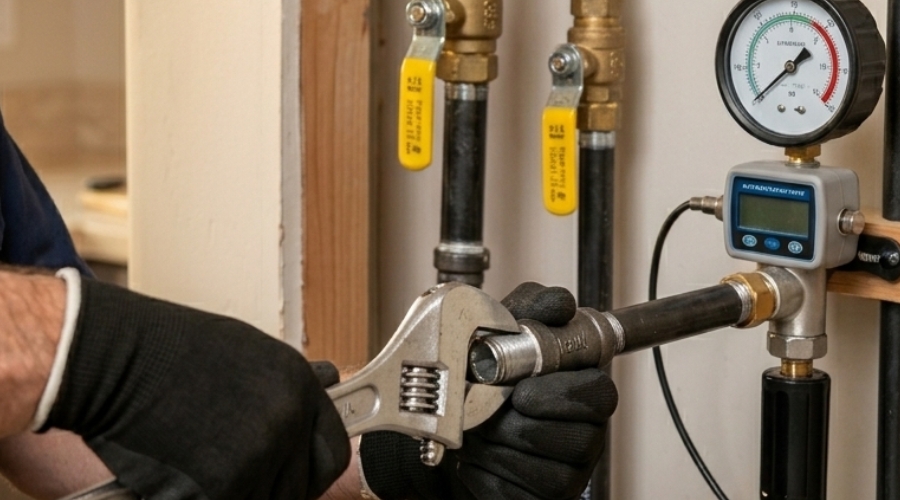
- Pressure Testing — A manometer test is performed to measure gas pressure at the meter and downstream components. Pressure drop indicates a leak or restriction somewhere in the system.
- Line Tracing and Inspection — We trace the gas line path — including any areas beneath slabs or behind walls — to identify the most probable failure zones using experience and field knowledge of how Las Vegas homes are typically constructed.
- PLAC Root Cause Evaluation — We assess the system for the four PLAC contributors: Pressure irregularities, Lack of maintenance on fittings and flex connections, Age of black iron or CSST components, and Corrosion from soil contact, moisture intrusion, or dissimilar metals.
- Code Compliance Review — We verify that existing and planned work aligns with the 2018 Uniform Plumbing Code and applicable Clark County requirements, including CSST bonding requirements and required clearances.
- Structured Options Presentation — We present repair and replacement options clearly — including scope, longevity expectations, permit requirements, and long-term system implications — before any work begins.
- Final Pressure Verification — After repair or installation, a final pressure test confirms system integrity. We don’t consider a job complete until testing confirms it.
Gas Line Repair vs. Replacement: How to Decide
| REPAIR IS OFTEN APPROPRIATE WHEN | REPLACEMENT IS OFTEN THE BETTER CHOICE WHEN |
|---|---|
| A single fitting, flex connector, or localized joint has failed | Multiple leak points are present along the same line |
| The line material is in good overall condition | Black iron pipe shows widespread corrosion or age-related deterioration |
| The failure is at a visible, accessible connection point | The leak is located beneath a slab or within a wall requiring access |
| Pressure testing confirms the rest of the system is sound | The system was not bonded to current code standards (CSST) |
| The home is newer and the system has had routine maintenance | The home is 25+ years old and the system has never been evaluated |
| Appliance relocation requires only a short run extension | You’re adding high-BTU appliances requiring system capacity upgrades |
In many Las Vegas homes we evaluate, the repair vs. replacement decision hinges on the age of the system combined with the extent of accessible piping. A localized fix on a 30-year-old black iron system may provide only temporary resolution if the broader system is compromised. Loyalty Plumbing walks through both paths honestly — we fix what the homeowner finds important and provide a clear picture of long-term implications.
Cost Considerations for Gas Line Work in Las Vegas
Loyalty Plumbing does not publish flat pricing for gas line work because accurate scoping requires a physical evaluation. Gas line costs vary based on a number of factors specific to each home and situation.
- Labor Complexity: Accessible repairs cost less than work requiring slab penetration, wall access, or running new lines through finished spaces.
- Line Length & Run: Extending gas service to a new outdoor kitchen, generator pad, or additional appliance requires material and labor proportional to distance.
- Permit Requirements: Clark County permits add a transparent, documented cost — and protect both the homeowner and the installation long-term.
- Material Selection: Black iron, CSST, and approved flex connectors have different material costs and installation labor requirements.
- System Capacity Work: Adding high-BTU appliances may require upsizing supply lines or adjusting pressure regulators, adding scope to the project.
- Emergency vs Scheduled: Scheduled gas work is typically priced more favorably than emergency response calls. When conditions allow, planning ahead reduces cost.
In older central Las Vegas and North Las Vegas neighborhoods where original black iron infrastructure is still present, complete gas line replacement often involves additional access work that differs from newer master-planned communities in Summerlin or Henderson. Our team provides a clear scope before any work begins.
DIY vs. Hiring a Professional for Gas Line Work
This is a straightforward category: gas line work is not a DIY project for homeowners.
Natural gas is odorless in its natural state — the sulfur odor is an additive specifically so leaks can be detected. Improper installation, inadequate pressure testing, or missed leak points can result in accumulation of gas inside a structure. The risks involved are categorically different from other household plumbing repairs.
Beyond safety, gas line work in Nevada requires a licensed plumbing or gas contractor. Homeowner-completed gas work is not code-compliant, will not pass inspection, and may void your homeowner’s insurance coverage. If the work is ever discovered during a home sale, it can create significant liability and legal complications.
That said, there are legitimate reasons homeowners ask: cost. A Loyalty Plumbing professional will always give you a clear scope and explain exactly what the job entails — so you understand what you’re paying for and why professional licensing and permit compliance are part of the investment, not inflated line items.
Frequently Asked Questions About Gas Line Repair in Las Vegas
What should I do immediately if I smell gas in my Las Vegas home?
Do not turn any switches on or off, do not use your phone inside the home, and do not light any flames. Leave the home immediately, move well away from the structure, and call NV Energy’s emergency gas line at 1-800-820-2234. Once the utility provider has cleared the home as safe to enter, call Loyalty Plumbing at (725) 237-2579 for a licensed evaluation and repair.
Does gas line repair or installation require a permit in Clark County?
In most cases involving new gas line installation, extended runs, or work tied to structural changes, a Clark County permit is required. Loyalty Plumbing pulls permits when the scope requires it — this protects your home, your installation warranty, and your insurance coverage. We do not perform unpermitted gas work.
How long does a residential gas line last in Las Vegas?
Black iron pipe systems, common in older Las Vegas homes, can last several decades when properly installed and maintained — but corrosion from soil contact or moisture intrusion can shorten that lifespan significantly. CSST systems installed since the 1990s are durable but require proper electrical bonding to meet current code. A professional pressure test and inspection gives you a clear picture of your system’s current condition and remaining service life.
Can I add a gas fire pit or outdoor kitchen to my Las Vegas home?
Yes, and outdoor gas appliances are a popular upgrade across Henderson, Summerlin, and Mountain’s Edge communities. However, outdoor extensions typically require a dedicated run from your main gas supply, proper sizing for BTU output, and a permit. Loyalty Plumbing assesses your existing system capacity first to confirm whether the supply can support the new load without pressure issues.
What is CSST and is it safe in Las Vegas homes?
CSST (corrugated stainless steel tubing) is a flexible gas piping system used in Las Vegas construction since the late 1980s. It is safe when properly installed with required electrical bonding, which protects it from lightning-induced electrical surges that can perforate the tubing. Many older Las Vegas homes have CSST that was installed before bonding requirements became standard — a professional evaluation can confirm whether your system is code-compliant.
My gas bill has increased significantly. Could that indicate a leak?
A notable and unexplained increase in gas consumption can be one indicator of a slow leak in the system. However, it can also reflect appliance inefficiency, thermostat settings, or seasonal usage. A pressure test by a licensed plumbing professional is the most reliable way to determine if the gas system itself is the source.
How is a gas line leak detected if it’s underground or behind a wall?
Pressure testing is the primary diagnostic tool — a measurable pressure drop over a set period confirms a leak is present somewhere in the system. The location is then identified by isolating sections of the line and, in some cases, using electronic leak detection equipment. In slab-on-grade Las Vegas homes, underground leak location requires field experience with how gas lines are routed through typical construction of each era.
How long does a gas line repair or installation typically take?
A localized repair — such as replacing a faulty flex connector or a corroded fitting — can often be completed in a few hours. A full gas line replacement or new installation involving extended runs and permit inspections typically takes one to two days, depending on accessibility and scope. Loyalty Plumbing provides a clear time estimate after the initial evaluation, before work begins.
Real Field Scenario: Las Vegas Home
REAL FIELD SCENARIO
Henderson Home, Built 1998 — Suspected Gas Leak Before Kitchen Remodel
A homeowner in the Green Valley area of Henderson contacted Loyalty Plumbing during the planning phase of a kitchen remodel. They mentioned that their gas range occasionally had difficulty igniting one burner and wanted to ensure the gas supply was adequate before their contractor began demolition.
During the initial evaluation, our team performed a pressure test on the existing gas line serving the kitchen. The test identified a slow but measurable pressure drop — consistent with a minor leak at one of the connections behind the existing range. On closer inspection, a corrugated flex connector showed micro-cracking at the fitting junction, consistent with age-related fatigue on a 25-year-old connector.
We also identified that the home’s CSST system, installed during original construction, was not bonded to current Clark County code standards. The homeowner hadn’t been aware this was a requirement.
Loyalty Plumbing replaced the faulty flex connector, performed CSST bonding to bring the system into compliance, and extended the gas supply line to accommodate the homeowner’s new range location within the remodel layout. A Clark County permit was pulled for the installation work. Final pressure testing confirmed full system integrity before we signed off.
The homeowner proceeded with their remodel confident the gas system was safe, compliant, and sized correctly for the new appliances.
Henderson | Built 1998 | CSST Bonding | Flex Connector Failure | Permitted Work | Kitchen Remodel
Why Working With a Licensed Las Vegas Plumbing Company Matters
Gas line work in Las Vegas involves variables that aren’t present in other markets. Our team at Loyalty Plumbing works specifically in the Las Vegas Valley — and that local experience directly shapes how we approach every gas system evaluation.
- We understand how slab-on-grade construction common to Clark County affects buried line routing and access
- We’re familiar with the CSST bonding gaps common in Las Vegas homes built in the 1990s and early 2000s
- We know how extreme desert temperature fluctuation affects fittings, connections, and flexible piping over time
- We work within Clark County permitting requirements and the 2018 Uniform Plumbing Code — no shortcuts
- We’re Nevada licensed and insured — homeowners have direct accountability to the owners, not a corporate call center
- Because our name and reputation are tied to every installation in this community, the standard doesn’t change regardless of job size
As a locally owned company, Nick and Alexy are directly involved in the quality of every job that goes out. There’s no management layer between a homeowner’s concern and a real decision-maker.
Final Summary: What Las Vegas Homeowners Should Know
Gas line repair and installation is one of the most safety-critical services in residential plumbing. In Las Vegas, the combination of aging infrastructure, slab foundations, desert soil movement, extreme temperature variation, and historical CSST bonding gaps creates a specific set of conditions that require a plumber who understands the local environment — not just general gas line procedure.
Whether you’re responding to a suspected leak, planning an appliance upgrade, or preparing for a remodel, the correct first step is a professional evaluation by a Nevada licensed plumbing contractor. Loyalty Plumbing approaches every gas line call through a structured diagnostic process — using the PLAC framework to identify root causes, presenting clear options without pressure, and performing code-compliant work backed by our Golden Guarantee.
We serve homeowners throughout Las Vegas, North Las Vegas, Henderson, and surrounding communities including Summerlin, Centennial Hills, Green Valley, Providence, Anthem, Enterprise, Mountain’s Edge, Skye Canyon, and more across the Las Vegas Valley.
Schedule a Gas Line Evaluation
If you suspect a gas issue, are planning an installation, or simply want a professional evaluation of your home’s gas system, Loyalty Plumbing is ready to help. We’ll assess the system honestly, explain your options clearly, and perform work to code.
